
Founder, Marketer, Solopreneur.
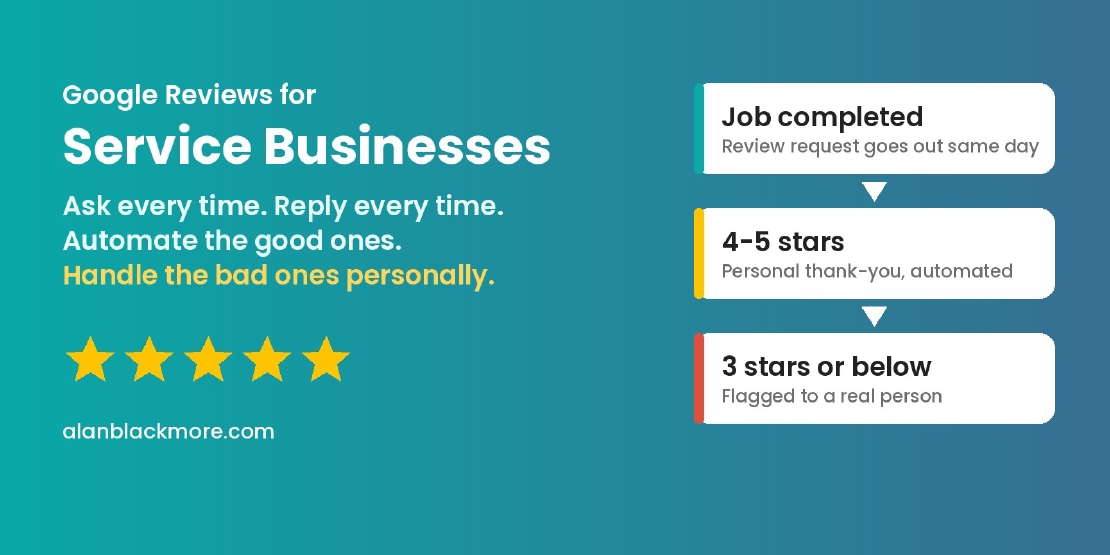

Google Reviews for Service Businesses: Ask Every Time, Reply Every Time, Automate (Almost) All of It
You did a good job. The customer was happy. They said “mate, that’s brilliant” on the way out.
And then nothing. No review. No star. No record anywhere that the job ever happened.
Multiply that by every job you’ve done this year and you’ve got a problem most tradies, cleaners and pool builders don’t even know they have. The work is good. Google just doesn’t know about it.
Here’s how to fix that, what to hand to a system, and the one part you should never hand to a system.
Why you should ask for a Google review after every job
Not some jobs. Not when you remember. Every job.
Reviews help you show up in local search and on Maps
When someone types “electrician near me” or “pool builder Perth”, Google decides which handful of businesses show up in the map results at the top. Google says local results are mainly based on relevance, distance and prominence (how well known a business is), and that prominence takes into account how many reviews you have. In Google’s own words, “more reviews and positive ratings can help your business’s local ranking.”
You can’t change how far you are from the customer. You can change how many reviews you have and how good they look.
Reviews do your selling before you pick up the phone
A homeowner looking for a cleaner has never met you. All they’ve got is a list of names, star ratings and review counts.
Picture two businesses side by side. One has 4.9 stars from 11 reviews. The other has 4.7 stars from 94 reviews. A lot of people will call the second one. More reviews looks like a business that’s busy, established and not going anywhere.
That’s the whole game. Trust gets the call, and the call gets the quote.
Recent reviews matter as much as good ones
If your last review is from 2023, a prospect wonders whether you’re still trading. Fresh reviews tell them you’re active, you’re working, and people are still happy with you this month.
You don’t get that from one big review drive a year. You get it by asking after every job.
Volume beats perfection
Every business gets the odd unhappy customer. If you’ve only got eight reviews, one bad one drags your rating down hard. With eighty, it barely moves the needle, and the good reviews around it put it in context.
Asking every customer is how you get there. Most happy customers will never think to leave a review on their own. They’re not being rude; they’re just busy. Ask them, make it easy, and a decent share will do it.
Ask everyone, and never pay for reviews
One rule here: ask everyone, not just the customers you think loved you. Google’s review policy says businesses must not “discourage or prohibit negative reviews, or selectively solicit positive reviews from customers” , and it bans offering incentives such as payment, discounts or free goods and services in exchange for a review. Google’s tips for getting more reviews repeat the point: incentivised reviews count as fake and misleading content.
Australian law backs this up. The ACCC warns that offering incentives for positive reviews risks misleading consumers and breaching the law, and that suppressing, editing or removing genuine negative reviews can mislead consumers too.
It’s also just better business. You want to hear from the unhappy ones too.
Why you should reply to the reviews customers leave
Getting the review is half the job. Replying is the other half, and most small businesses skip it.
Prospects read your replies
When a potential customer scrolls your reviews, they’re not only reading what past customers said. They’re reading what you said back.
A business that thanks people by name and replies like a human comes across as one that cares. A business with 60 reviews and zero replies looks like nobody’s minding the shop. Which one would you trust in your house?
Google recommends it
Google encourages businesses to reply. Its help page on reading and replying to reviews says that replying shows customers you value their feedback and that helpful, positive replies show you’re responsive. “Respond to reviews” also sits on Google’s own list of tips to improve your local ranking , alongside keeping your details up to date and adding photos.
It builds loyalty with the customers you already have
A short, genuine “Thanks Sarah, the new pool looked great on handover day, enjoy summer” does more than you’d think. Customers remember being thanked. They’re more likely to come back, and more likely to send their neighbour your way.
Referrals are how most service businesses survive. Replying to reviews keeps the referral engine warm.
Why you should automate asking for reviews and replying to good ones
You already know you should ask for reviews and reply to them. It isn’t happening because you’re flat out doing the actual work.
That’s what automation is for.
Consistency: every customer gets asked
A system doesn’t have good weeks and bad weeks. It doesn’t skip the Friday arvo job because everyone wanted to knock off. Once a job is marked done, the customer gets the request. Every time.
That’s how you turn “we get a review now and then” into a steady flow. It also keeps you on the right side of the “ask everyone” rule above, because the system doesn’t pick favourites.
Timing: ask while the job is fresh
The best time to ask for a review is when the customer is standing in their new kitchen or looking at their clean carpet. Wait two weeks and the moment has gone.
An automated text or email can go out the same day the job is finished, with a direct link to your Google review page. Google lets you create a review request link or QR code for exactly this. One tap and they’re writing. A gentle reminder a few days later catches the people who meant to do it and forgot.
Nobody has to remember
Right now, asking for reviews probably depends on whoever’s on site remembering to bring it up. Memory loses to a busy week every time.
Automate it and it stops being anyone’s job. It just happens. If you’re already using email automation for follow-ups, a review request is a natural next step in the same sequence.
It saves hours
Replying to every 5-star review by hand, chasing customers, copying links into texts: it adds up to hours every month you could spend quoting, working or having a weekend.
What to automate
- Review requests. A text or email after every completed job, with your Google review link, plus one follow-up reminder. Only email customers who’ve given you permission to contact them that way.
- Replies to 4- and 5-star reviews. A warm, personal-sounding thank-you that uses the customer’s name and, where possible, mentions the job. Not a copy-paste “Thanks for your review!” on every one. Google’s own advice on review replies says the same: don’t send everyone the same “thank you”. Customers can tell, and so can prospects.
Good review automation should sound like you on a good day. If the replies read like a robot wrote them, they’re doing more harm than good.
Why 3-star-and-below reviews should never be auto-replied
This is the part a lot of people get wrong, so read it twice.
Do not automate replies to bad reviews. Not even a polite template.
A real person needs to read every one
A 2-star review is a customer telling you something went wrong. Maybe they’re right. Maybe they’re partly right. Maybe it’s a misunderstanding. You won’t know until someone in the business actually reads it and looks into what happened on that job.
An automated “We’re sorry to hear about your experience, please contact us” tells the customer, and every prospect reading it, that nobody cared enough to look.
Write a genuine, specific response
Once you know what happened, reply properly. Use their name. Acknowledge the problem without getting defensive. Say what you’re doing about it. Keep it short and calm. Never share the customer’s private details in a public reply.
Remember who you’re really writing for. The unhappy customer will read it, sure. But so will every future customer who scrolls past it. A fair, professional reply to a bad review can win you more trust than another 5-star review ever will.
Fix it with the customer, offline
A bad review is often a second chance in disguise. Pick up the phone. Find out what went wrong. Offer to fix it if you can.
Google itself notes that constructive replies and following up on concerns can show you care and may even encourage the customer to update their review. Even if they don’t, you’ve done the right thing, and anyone reading your reply can see you tried. Just don’t offer anything in exchange for changing or removing the review. That’s an incentive, and both Google and the ACCC take a dim view of it.
Fix the system so it doesn’t happen again
Every bad review is free feedback about a gap in how you work. Ask yourself why it happened. Was the quote unclear? Did the team leave a mess? Did nobody call when you were running late?
Then change your process. Update your standard operating procedures (SOPs), the written checklists and steps your team follows on every job, so the same problem doesn’t come up next time. Brief the crew. Fix the checklist.
One bad review, handled properly, can stop the next twenty from happening. That’s why it needs a human, and why it should never be left to a machine.
The simple system, in one line
Ask every customer, reply to every review, automate the good stuff, and personally handle the bad stuff.
It isn’t complicated. It just needs to happen every single time, and that’s what a good setup does for you.
Want help setting this up?
I help service businesses in Australia set up review systems that ask every customer at the right time, reply to happy customers in your voice, and flag the 3-star-and-below reviews straight to you so you can deal with them personally.
If you’re tired of doing great work that nobody sees on Google, get in touch and let’s have a chat about what it would look like for your business.
Get in touch about review automation Book a call
Related reading: Growing a Small Business with Email Marketing